Why Battery Storage Matters for Bedford Homes and Businesses
Battery storage is transforming how Bedford households, shops and workplaces use electricity. Rather than sending daytime solar generation straight to the grid or paying peak prices in the evening, a modern battery captures spare power and releases it later when it is most valuable. The result is higher self-consumption of solar PV, lower bills through tariff optimisation, and improved resilience when paired with an emergency power supply circuit. For a town that blends Victorian terraces, new-build developments in Wixams and Great Denham, and a thriving mix of independent retailers and light industry, the flexibility of storage fits a wide range of properties.
At its core, a home or commercial battery turns kilowatt-hours into a strategic asset. During sunny hours or off-peak tariff windows, a battery charges; when the sun sets or prices rise, it discharges to power appliances, lighting, or even an EV charger. With time-of-use tariffs becoming more common, shifting demand in this way can shave a meaningful percentage off annual costs. In Bedford’s residential areas—Kempston, Biddenham, Bromham—families typically run their highest loads in the early evening. A 5–10 kWh battery can cover cooking, entertainment and background loads without drawing as heavily from the grid.
Storage also helps manage carbon impact. By using more of what is generated on-site, properties reduce dependence on higher-carbon grid electricity during peak periods. For businesses—from offices in the town centre to warehouses along key routes—batteries can smooth demand spikes, support lighting and IT infrastructure, and integrate with solar or EV charging. Some systems offer an EPS (emergency power supply) to keep critical circuits live during a power cut, a particular benefit for home working, refrigeration, or essential equipment. While not every system provides whole-property backup, careful design can safeguard high-priority circuits like broadband, lighting, and heating controls.
There’s a safety and compliance dimension, too. Properly specified and installed batteries, compliant with the latest BS 7671 wiring regulations and the IET Code of Practice for Electrical Energy Storage Systems, deliver stable, predictable operation. When matched to the property’s electrical capacity, typical daily usage, and roof orientation (where solar is included), Bedford residents gain predictable bill reductions and a more comfortable level of energy independence.
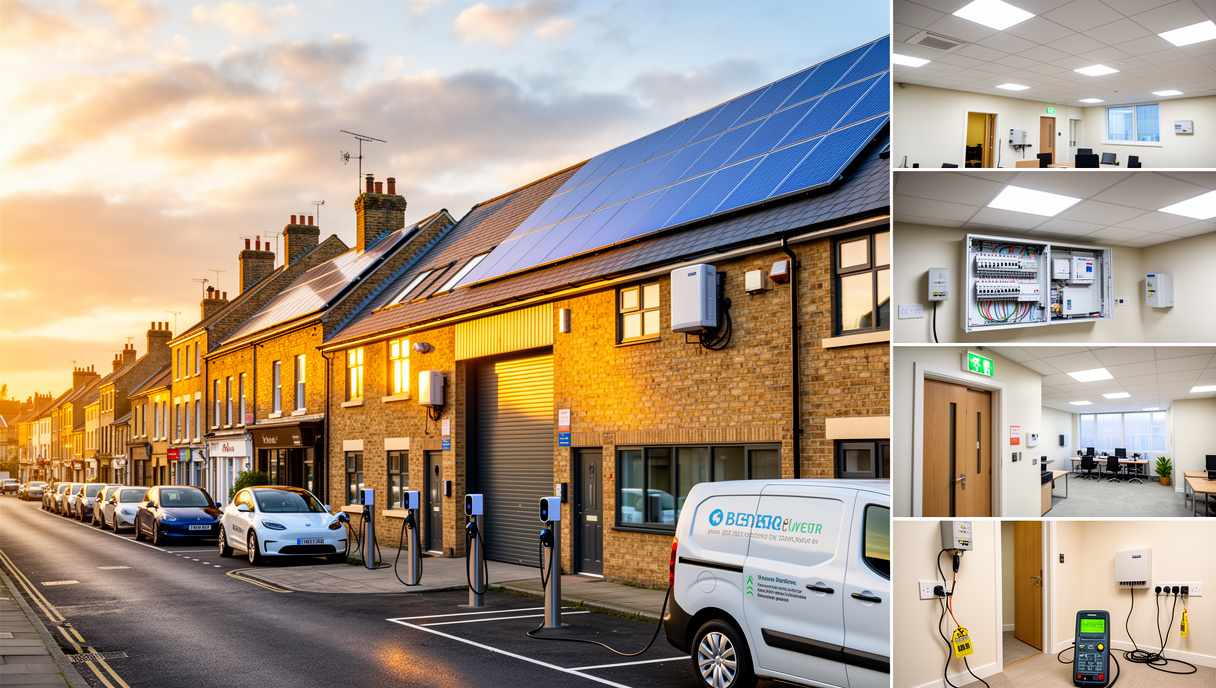
Choosing the Right System: Sizing, Safety and Installation Considerations
Design begins with honest numbers. A typical Bedford household might consume 8–12 kWh per day, peaking between 5–9 pm. If solar PV is present—say 3–5 kWp—the goal is to capture midday surplus and release it for the evening peak. A 5–10 kWh battery fits many three-bedroom homes, while larger or all-electric homes (with heat pumps or EVs) might step up to 12–20 kWh. For shops and small offices, 10–30 kWh can moderate daytime spikes, and for larger commercial premises, modular systems scale well beyond that with three-phase options.
Two main architectures are common. DC-coupled systems connect on the solar side of a hybrid inverter, reducing conversion losses and often suiting new PV-plus-battery installations. AC-coupled systems sit on the property’s AC side, making them ideal for retrofits where solar already exists and the inverter is staying put. In Bedford’s varied housing stock—lofts in older terraces, garages in newer estates, utility rooms in detached homes—equipment placement must balance safety, access and temperature stability. Garages and utility areas are popular because they’re accessible for maintenance and keep batteries away from living spaces.
Safety and compliance are non-negotiable. Installations should follow manufacturer guidance, ensure adequate clearance and ventilation, and consider fire detection where recommended. UK standards, including BS 7671 and the IET’s storage guidance, help define best practice for cabling, earthing, and protection devices. Depending on system size and configuration, the local Distribution Network Operator (DNO) may require notification (G98) or prior approval (G99). For properties in and around Bedford—from Elstow to Sharnbrook—network constraints vary, so early checks prevent delays and ensure that export limits and protection settings are correctly applied.
Smart features now shape long-term value. Cloud-connected apps track charge state, forecast solar yield, and automate time-of-use optimisation. Some platforms integrate EV charging to prioritise cheap or green energy. Others support an EPS to run selected circuits during an outage; this requires careful load assessment and a suitably rated changeover arrangement. Warranty terms—a common window is 5–10 years with a cycle limit—affect lifetime cost. Lithium iron phosphate (LFP) chemistry, now prevalent in quality systems, offers strong cycle life and robust safety characteristics.
Local specialists who understand property types, DNO processes and current tariffs can streamline the journey from concept to commissioning. For tailored design, installation and maintenance delivered by Bedford-based electricians, explore Battery Storage in Bedford to align capacity, control strategy and compliance with real-world usage.
Bedford-Focused Scenarios, Costs and ROI: What to Expect
Every property is different, but patterns emerge across Bedford’s housing and commercial landscape. Consider a family in Kempston with a 4 kWp solar array and a 10 kWh battery. Daytime generation that used to spill to the grid is now stored and released between 6–10 pm. With modest lifestyle tweaks—dishwasher and washing machine set to midday or off-peak hours—self-consumption can climb from 30–40% to 70–85% in spring and summer. Annual bill reductions vary with tariff and usage, but for households on time-of-use rates, hundreds of pounds per year in savings is common, and even standard tariffs see meaningful reductions when solar is present.
A small office in Bedford town centre might implement a 20 kWh AC-coupled system to flatten peaks caused by printers, air conditioning and server rooms. Pairing storage with LED lighting and smart controls tightens the load profile and can act as a buffer against voltage dips, improving equipment reliability. For schools or community facilities in areas like Biddenham or Bromham, a 30–60 kWh system teamed with rooftop solar can support daytime activities, reduce import during events, and lay groundwork for future EV charging bays. In each case, system control logic matters: charging during low-cost periods and discharging when tariffs spike safeguards cashflow while also supporting grid-friendly demand shifting.
Costs depend on brand, capacity and site complexity. As a guide, domestic installations in the 5–10 kWh range often land between £3,000 and £8,000 installed, while commercial systems scale from there. Batteries with premium features—higher continuous power, integrated EPS, advanced software—command higher prices. Against this, the UK’s zero VAT on domestic energy-saving materials currently applies to battery storage when installed in qualifying situations, which can improve the payback equation. Meanwhile, households with solar can still benefit from the Smart Export Guarantee (SEG) for genuine surplus; however, many owners find that boosting self-use through storage provides stronger value than exporting at low rates.
Real-world returns hinge on three levers. First, right-sizing matched to daily habits: a well-chosen capacity cycles regularly, capturing the best of solar and off-peak energy without spending on unused storage. Second, tariff strategy: predictable off-peak windows unlock consistent savings; dynamic tariffs reward flexibility and smart automation. Third, longevity: selecting robust LFP-based systems with clear cycle warranties, keeping firmware updated, and scheduling periodic electrical checks sustains performance over time. In Bedford’s climate—bright spring and summer days, variable winters—expect seasonal swings in solar contribution, with batteries adding the most value from March to October and still enabling off-peak shifting year-round.
Location and installation quality complete the picture. Garages and utility rooms help maintain stable temperatures and easy access. Clear labelling, appropriate isolation and surge protection, and coordination with existing consumer units ensure safe integration. For homes with limited space, wall-mounted slimline units fit neatly; for businesses, modular cabinets grow with future needs. With thoughtful design and accredited installation, battery storage turns a property’s electrical system into an active, optimised asset that supports comfort, resilience and lower energy costs across Bedford and the wider Bedfordshire area.

Lagos fintech product manager now photographing Swiss glaciers. Sean muses on open-banking APIs, Yoruba mythology, and ultralight backpacking gear reviews. He scores jazz trumpet riffs over lo-fi beats he produces on a tablet.