Why powerful product photography matters for handmade and high-end goods
Handmade jewelry, watches, and accessories have a singular magic: every edge carries intent, every finish reveals hours of skilled work. Yet online, where touch and weight disappear, visuals do all the talking. Great product photography for artisans doesn’t merely show an item—it conveys craft, credibility, and value in a heartbeat. Clear, consistent images lift perceived quality, justify premium pricing, and reduce hesitation that can stall a sale. From marketplaces to your own store, crisp photos act as silent salespeople that operate 24/7, telling the story of process, materials, and care.
Trust is built through tiny details. A gemstone’s facet pattern, the glide of a watch crown, the grain of vegetable-tanned leather—these micro-cues establish authenticity. That’s why macro detail shots, true-to-color packshots, and on-model scenes are a winning trio. A polished packshot gives buyers the unvarnished truth; styled lifestyle images add narrative and mood; on-model photography supplies scale and wearability. Combined, they answer the silent questions customers ask: How big is it? How does it sit on the hand? Does the clasp feel substantial? Strategic sequences of images can guide a visitor from intrigue to purchase with almost no words.
Artisans also benefit from brand consistency. Cohesive backgrounds, repeatable angles, and uniform lighting form a recognizable visual identity—a powerful signal in crowded feeds. If your thumbnails look unified, customers are more likely to click. On product pages, consistency reduces cognitive load, helping shoppers compare variants and move smoothly through options like sizes, materials, or finishes. And beyond aesthetics, precision imagery lowers returns: when color and texture are accurately shown, expectations match reality.
Finally, well-executed visuals supercharge discoverability. Search-friendly filenames and descriptive alt text help images surface in queries for “handmade gold hoop earrings” or “sapphire cushion-cut ring.” Fast-loading, optimized images enhance site performance and mobile conversions. In a world where attention is scarce, investing in studio-quality visuals is not a luxury; it’s a revenue engine—especially when your work is small-scale, reflective, or detail-driven.
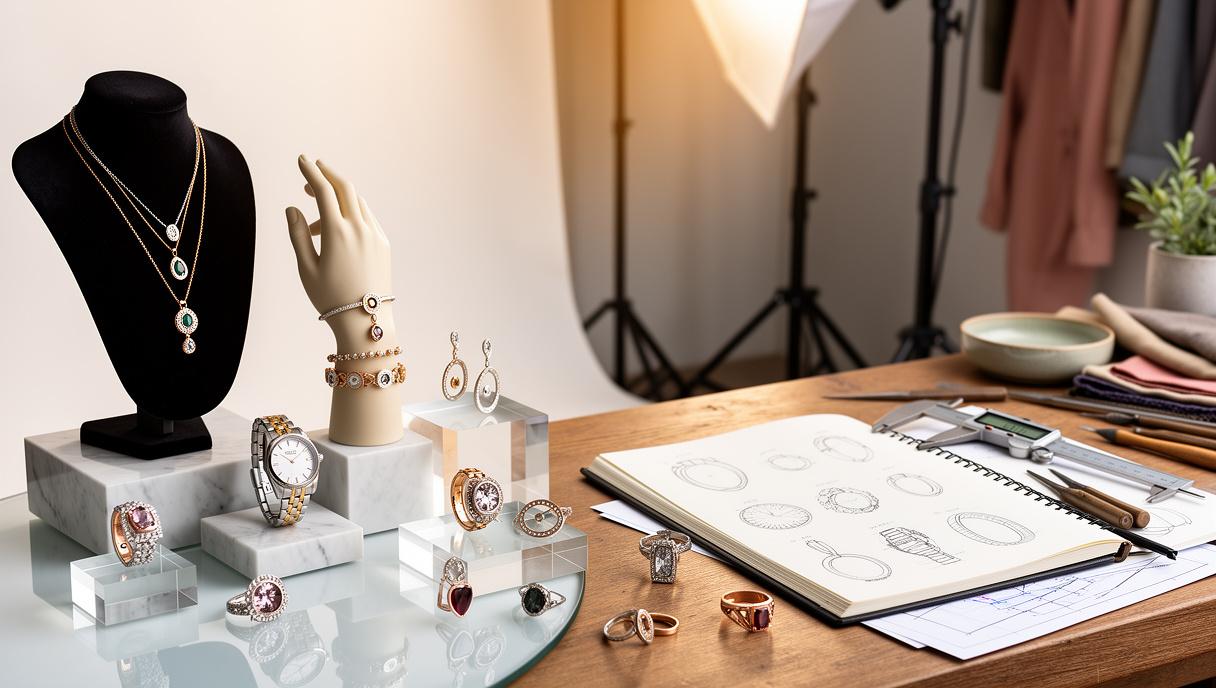
Techniques and workflows tailored to jewelry, watches, and accessories
Lighting is the backbone of product photography, and artisanal goods demand finesse. Soft, diffused light reveals form without harsh hotspots, while thoughtful use of reflectors and negative fill sculpts contrast. For highly reflective pieces—polished watch cases, mirror-finish bangles, pavé settings—double diffusion and light tents tame chaotic reflections. Polarizing filters can cut glare from crystals or lacquered leathers; white acrylic sweeps create clean horizons for elegant packshots. Keep lighting repeatable by measuring height and angle, then documenting the setup to preserve consistency across collections.
Color accuracy matters: set custom white balance with a gray card, build a color-managed workflow, and export in sRGB for the web to ensure buyers see the tone they’ll receive. For small jewelry, use focus stacking to achieve tack-sharp images from front to back; even shallow plane shifts can blur prongs or gemstone tables if you rely on a single exposure. Mind the specular highlights—gentle banded reflections add perceived luxury to a watch bezel, while harsh pinpoints can feel cheap. For gems, a balance of brilliance and dispersion reads as premium; for brushed metals, even texture is key.
Angles and framing should be planned. Establish a hero angle (popular options include 45-degree three-quarter, top-down, and profile) and repeat it per SKU. Add secondary shots for closures, buckles, clasps, stone settings, or stitch work. Backgrounds do heavy lifting: neutral whites for compliance and clarity; textured stone, linen, or soft wood for tasteful lifestyle context. Props must never overshadow the piece—think complementary rather than competitive. On-model imagery builds confidence: choose skin tones that flatter metal hues, mind lint and fingerprints, and ensure proper fit (watch straps should lay smooth, rings should neither pinch nor spin).
Today’s visual production can be faster and more flexible. With modern, craft-focused tools, you can turn sketches and CAD files into realistic, launch-ready images, test styling directions, and swap environments without reshooting. Smart editing accelerates dust removal, metal cleanup, and gemstone enhancement while preserving authenticity. Need packshots, lifestyle scenes, and on-model variations in 2K or 4K? Virtual studios and intelligent retouching deliver scalable results for e-commerce, social feeds, and print—keeping image quality consistent across the entire customer journey.
From bench to browser: building an efficient visual pipeline for artisans
A reliable pipeline converts artistry into consistent, high-performing visuals. Start with pre-production: define a visual North Star (lighting mood, color palette, and styling guardrails). Build a shot list per SKU that covers essentials: a clean packshot on white, two to three angles, macro detail, a size/scale reference, a lifestyle scene, and on-model wear. For collections, plan a hero scene to unify the lineup. Prepare surfaces and props in advance, gather lint-free cloths and antistatic tools, and keep a tamper-free kit for handling delicate pieces. If working with CAD or design sketches, align materials and finishes early to ensure visual accuracy upon launch.
During production, shoot tethered to review focus, highlight roll-off, and alignment in real time. Check histograms to avoid crushing shadows on blackened silver or clipping highlights on polished steel. Maintain naming conventions that map files to SKUs and variants; back up as you go. Create a quick quality-control checklist: dust removal, chromatic consistency across metal tones, straight horizons, and true scale representation. After the shoot, standardize crops and aspect ratios for platforms (1:1, 4:5, 3:2) and apply gentle, consistent sharpening. Optimize image sizes for speed without sacrificing clarity, and write keyword-rich alt text that reflects material, cut, and use case.
Case-in-point scenarios show how thoughtful imagery pays off. A jeweler launching a hammered silver ring might use focus stacking to showcase texture, a lifestyle shot on slate to evoke craft, and an on-hand image for scale—elevating click-through on marketplace search results. A leatherworker can photograph a tote’s interior layout, show a laptop for scale, and capture strap drop on-model—reducing returns. A watch microbrand benefits from controlled banded reflections across the bezel, an angled crown close-up, and a lume glow frame—details that signal engineering quality. Across all, consistency in tone and lighting unifies collections and boosts brand memory.
Modern platforms built for luxury craft streamline this pipeline by offering drag-and-drop virtual studios, smart editing, and rapid asset generation across packshots, lifestyle scenes, and on-model visuals. They help artisans scale content for seasonal campaigns, test backgrounds and angles, and spin up 2K and 4K outputs without the overhead of traditional shoots. If your goal is faster launches with impeccable consistency, explore solutions purpose-built for Product photography for artisans. They’re especially effective when selling across channels—your own shop, marketplaces, social ads, and print—ensuring every image preserves the essence of your workmanship from booth to browser, and from prototype to polished collection.

Lagos fintech product manager now photographing Swiss glaciers. Sean muses on open-banking APIs, Yoruba mythology, and ultralight backpacking gear reviews. He scores jazz trumpet riffs over lo-fi beats he produces on a tablet.